GaN Chargers: What Changed and Whether It Matters to You
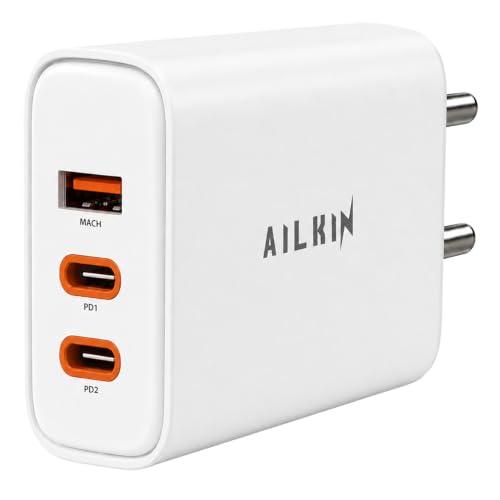
Every charger above about 30W now advertises GaN. It is a genuine engineering improvement rather than marketing, but what it improves is often misunderstood.
What GaN actually is
Chargers convert mains AC to low-voltage DC by switching current on and off very rapidly. The component doing that switching has traditionally been made of silicon.
Gallium nitride switches faster and wastes less energy as heat. Two consequences follow directly:
- Faster switching means the transformer and capacitors can be smaller, so the whole charger shrinks — often to half the size of a silicon equivalent
- Less wasted heat means the charger runs cooler, which also means it is less likely to throttle back when it warms up
What GaN does not do
It does not make charging faster. Charging speed is set by the protocol and wattage negotiated between charger and device — see fast charging standards. A 65W GaN charger and a 65W silicon charger deliver the same 65W to the same phone.
The one indirect exception: a charger that overheats will reduce its output to protect itself. Because GaN runs cooler, it is more likely to sustain full output over a long charge, particularly in a warm room. In an Indian summer, without air conditioning, that is not a trivial difference — but it shows up as consistency, not peak speed.
The honest summary
GaN buys you size and heat, not speed. If you travel, or want one charger for a laptop and phone that does not dominate a bag, it is clearly worth it. If a charger sits permanently behind a bedside table, the benefit is close to zero.
Where it genuinely helps
- Travel. One compact 65W GaN charger can replace a laptop brick and two phone chargers. This is the strongest case.
- Multi-port chargers. Higher total wattage in a housing that still fits a socket without blocking its neighbour.
- Hot environments. Sustained output where a silicon charger would throttle.
- Crowded power strips. A smaller body is a practical win on an extension board.
What to check beyond the GaN badge
GaN says nothing about the things that determine whether the charger suits you. On the listing, look for:
- Protocols supported — PD, PPS, QC. Without the right protocol the wattage is unreachable.
- The per-port power split. A 65W three-port charger gives 65W only to one port alone. The listing should show the table.
- Plug type. Some are sold with a foldable US plug and a loose adapter. For India you want an Indian pin type, ideally moulded.
- BIS certification. Required for legal sale in India and a reasonable baseline of safety testing.
- Whether a cable is included, and at what rating. Many high-wattage chargers ship with no cable, or with a 60W one.
Is a cheap GaN charger a false economy?
GaN components cost more than silicon, so an unusually cheap GaN charger has saved money somewhere. Sometimes that is fine; sometimes it is the protection circuitry, the insulation, or the accuracy of the wattage claim.
A reasonable rule: a charger is connected to mains electricity, sits unattended, and often runs overnight. It is worth buying from a brand that can be held responsible, with BIS marking and stated protections. The saving on an unbranded one is small compared with what it is plugged into.