Wireless Mouse Specifications: What Matters and What Is Marketing
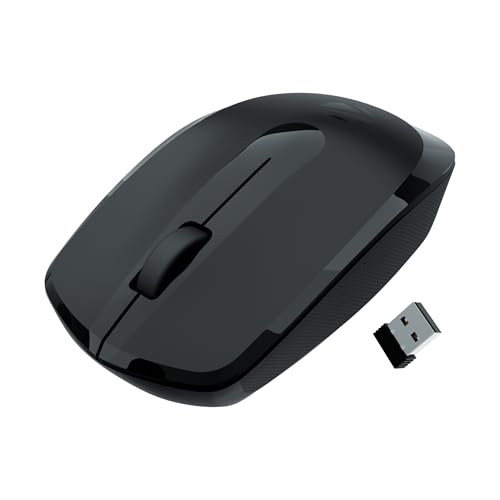
Mouse listings compete on DPI, and the figures have escalated to absurdity — 16,000, 26,000, higher. Almost nobody uses more than a small fraction of it.
DPI, and why the big number is irrelevant
DPI (or CPI) is how far the cursor moves per inch of hand movement. Higher means a smaller hand motion crosses the screen.
Most people are comfortable between 800 and 1600 DPI. On a 1440p screen, 1600 DPI crosses the display with a modest wrist movement. At 16,000 DPI a twitch sends the cursor from one edge to the other, which is unusable rather than precise.
A high maximum is not harmful — you simply set it lower — but it says nothing about sensor quality. What matters is that the sensor tracks accurately and consistently at the DPI you actually use, and that is not something the headline number tells you.
A mouse advertising 26,000 DPI and one advertising 4,000 DPI will feel identical at the 1200 DPI you end up using.
Polling rate
How often the mouse reports its position — 125Hz, 500Hz, 1000Hz. Going from 125Hz to 500Hz is perceptible as smoother cursor motion. Beyond 1000Hz the difference is measurable and, for anyone outside competitive gaming, invisible.
Higher polling rates consume more battery on a wireless mouse, which is a real trade-off for an office device.
What actually decides whether you like it
Shape and size
This is the whole thing, and it is the hardest to judge online. A mouse too small for your hand forces a claw grip and tenses your fingers; too large and you cannot reach the buttons comfortably. Listings state length and width — compare them against a mouse you already find comfortable rather than guessing.
If you use a mouse for hours daily and have any wrist discomfort, a vertical mouse is worth considering. It holds the forearm in a neutral handshake position rather than rotated flat. It takes a few days to adapt to.
Weight
Light (under about 80g) suits fast movement and long sessions. Heavier feels more planted and deliberate. Neither is better; a heavy mouse simply costs more effort over a working day.
Connection
| Type | Latency | Notes |
|---|---|---|
| Wired | Lowest | No battery, no pairing; cable drag |
| 2.4GHz USB dongle | Very low | Occupies a USB port; losing the dongle can end the mouse |
| Bluetooth | Higher | No dongle; occasional wake delay |
Many good mice do both wireless modes. The dongle for gaming or a desktop, Bluetooth for a laptop with few ports. Check whether a lost dongle can be replaced — for some brands it cannot, which makes it a single point of failure.
Battery
- Rechargeable — no cells to buy, but it must be charged, and the cell eventually degrades with the mouse
- AA or AAA — swap a cell and continue immediately; some run for a year or more. Heavier, but nothing to plan around
The small things worth checking
- Silent switches, if you work near others or take calls. The click is dampened, not removed, and it is a bigger quality-of-life change than most specifications.
- Scroll wheel behaviour. Notched wheels give precise single lines; free-spin wheels fly through long documents. Some do both.
- Multi-device switching — pairing to two or three machines and switching with a button. Useful with a work laptop and a personal one.
- Surface. Optical sensors struggle on glass and on high-gloss desks. A cheap mousepad fixes tracking problems people often blame on the mouse.
Buying priority
- Shape and size for your hand
- Connection type that suits your machines
- Weight and switch noise
- Battery arrangement
- DPI — last, and almost never the deciding factor